
As the President and his team head into midterms season in earnest, a huge mystery hangs over the nation: The economy is in great shape—but most voters feel absolutely horribly about it.
We are officially in a vibecession.
Not a recession—that’s when the economy is bad—but a VIBE-cession: That’s when the economy is good, but the vibes just suck.
Americans in poll after poll say the economy feels bad.
Consumer sentiment right now is worse than it was during the Great Recession—even though by all measures, Trump’s economy is chugging along splendidly. The majority of Americans feel like the economy is worse in 2026 than it was in 2008—when 10 million Americans lost their homes, 8 million lost their jobs, and unemployment skyrocketed to 8%.
Compare that to now: The private sector just added 172,000 jobs in January. Unemployment is down to 4.3%. Inflation is down to 2.4%—its lowest in five years. Gas is down to $2.90 a gallon. The S&P500 reached record highs last year.
And it’s not just the fat cats on Wall Street reaping the benefits. Average hourly wages rose by 3.7% since Trump took office, with non-supervisory wages—meaning workers, not college-educated managers—continuing to rise.
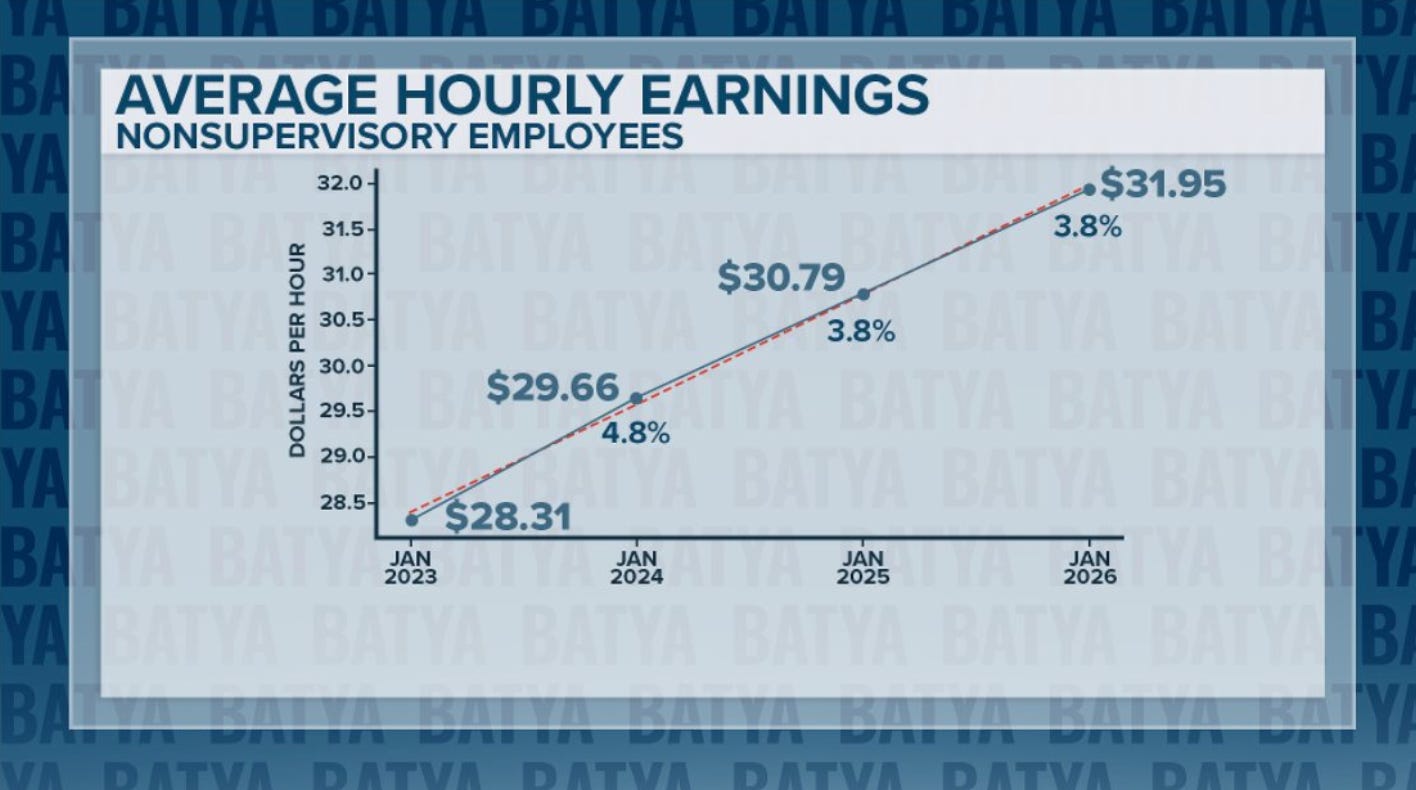
In fact, blue collar wages grew much faster in 2025 than they did in the five years previous—especially for folks making forty to ninety thousand dollars a year, whose wages grew at double the rate of people making over $125,000 a year.
Trump’s economy is literally shrinking the income gap between the credentialed elites and the working class—thanks, as we’ve argued here at great length, to his tariffs and his mass deportations, both of which are laser focused on improving the value of the labor of the working class.
But… voters aren’t feeling it.
What gives?
One answer, supplied by the very liberal website Vox, is that it’s the credentialed class that’s skewing the numbers. In a piece exploring the vibecession, Vox concluded that
“white-collar workers likely exert disproportionate influence over how economic conditions are perceived, since we enjoy an outsize voice in journalism and politics. Given that clout, the fact that job and wage growth has been especially weak in white-collar sectors might partly explain the darkening national mood.”
The fact that white collar workers are much more likely to be Democrats, and political affiliation has become a major predictor for whether a voter thinks the economy is doing well, might explain a lot.
Whatever its cause, the vibecession conundrum is something the Trump administration is going to have to dance around in the march to the midterms. If it’s one thing voters hate, it’s when you do what I just did: tell them things are better than they think they are.
That was the advice given in a closed-door midterms strategy session assembled by Trump’s chief of staff Susie Wiles. About 100 people gathered, including high-level cabinet members, according to reporting by Mark Halperin, and they were presented with a plan for the midterms by pollster and strategist Tony Fabrizio. Here’s a summary of the messaging on the economy:
The economy will be THE issue in the election, he said. Messages that break through: Banning stock trading for Congress, transparency on health insurance data (including on pricing and claims reimbursement), lowering prescription drug costs, the Trump tax cuts.
Housing affordability is a huge issue for voters, especially young people.
Taking credit for closing the border does not resonate much…Trying to argue about wages being up will not help; voters have to feel it.
You hear it again and again: Biden lost because he lectured Americans on the economy, because he told them it was doing well when it wasn’t and they knew it.
Does the same rule apply when you’re telling them things are getting better—and they are?
It may be a losing political message, but I’m not a politician. My job is to tell you the truth as best as I can. And it might be unpopular to say it, but the truth is, things are getting better for working-class Americans. The question is, will they feel it before the midterms.
Every time I see on the street interviews it’s easy to understand. There are a lot of truly ignorant people out there.
The presstitutes constantly spin. I listen to a radio station where the hourly news comes from ABC and Bloomberg. The bias is very apparent as they downplay good stats and throw in speculative warnings to temper the good news .