
Ever since President Trump imposed global reciprocal tariffs on countries across the globe (who all have tariffs on us!), Democrats, liberal pundits, and economists on cable news have been repeating the same catch phrases like sacred mantras: “Tariffs are a tax on consumers!” “Tariffs hurt working families!” “Tariffs cost the average American thousands of dollars a year!”
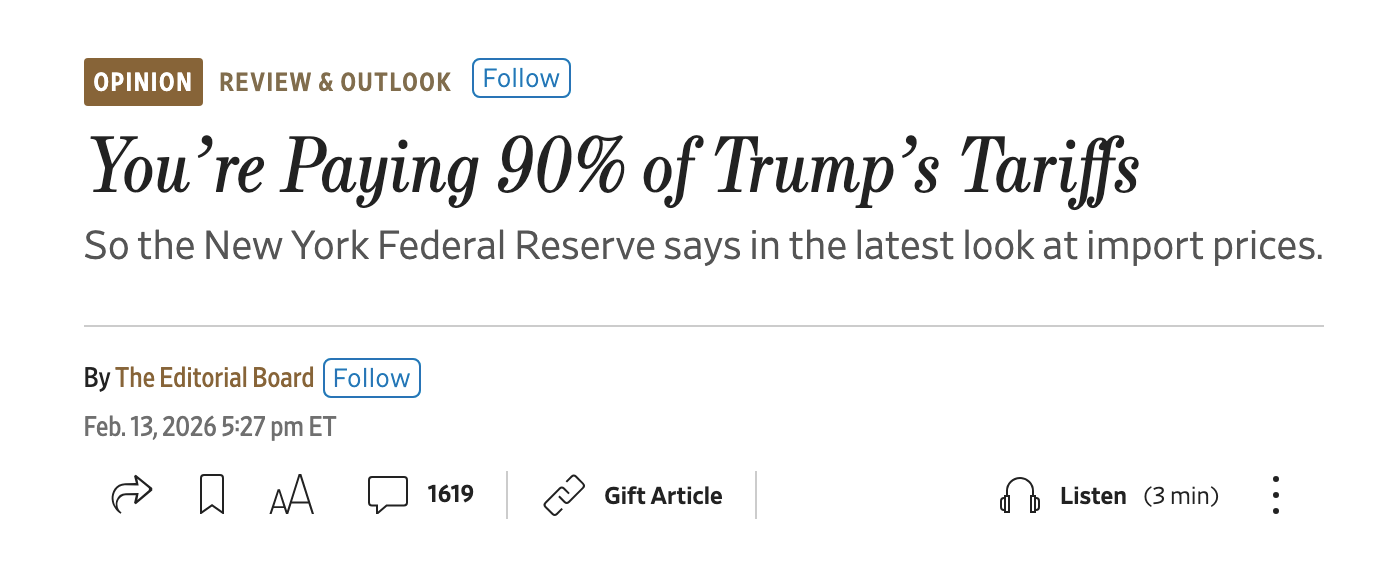
Every few weeks we’re treated to the “latest proof” that Trump’s tariffs have been passed on to you, that they have been massively inflationary, that Trump is costing you thousands of dollars every month. The latest in this series is a Wall Street Journal editorial claiming to show based on new research from the New York Federal Reserve that “You’re Paying 90% of Trump’s Tariffs.”
The only problem is, it doesn’t show that—at all.
The article posted to the New York Federal Reserve’s website doesn’t even claim to show that “you’re paying” the tariffs. It claims to show that based on who paid the import duty of the tariffs, “nearly 90 percent of the tariffs’ economic burden fell on U.S. firms and consumers” (my italics).
Did you catch that? The tariffs are being paid by you—the consumer—and “U.S. firms.” So, you and Walmart. You and Target. You and Nike. You and Amazon. You and every other multi-billion dollar corporation. They paid the import duty—and thus you and they paid the tariff. Note the slippage: The New York Fed, like the WSJ, just assumes that the companies passed on that extra cost to you, without actually proving it—then acts like they have proven it.
Yet the whole question at the heart of whether the tariffs are good or bad is how that breaks down: Did they pass on the cost in the form of higher prices? Who ultimately paid? Is it you, or is it them? If it’s you, that’s bad! If it’s them, who cares?
Well, the WSJ apparently cares! The editorial board is very exorcised about “the economic dynamism that’s wasted when companies devote time and talent to reacting to Mr. Trump’s mercurial tariff whims.” But I think many of us would sacrifice that “economic dynamism” in exchange for everything the tariffs have accomplished: massive trade deals that favor the U.S., access to Japanese and South Korean markets for our cars, Mexico finally policing its side of the border, the reshoring of manufacturing—including drugs, and of course, the $300 billion in revenue, which went to pay down one fifth of our national deficit in just one year. But hey, what’s all that compared to a loss of “economic dynamism”!
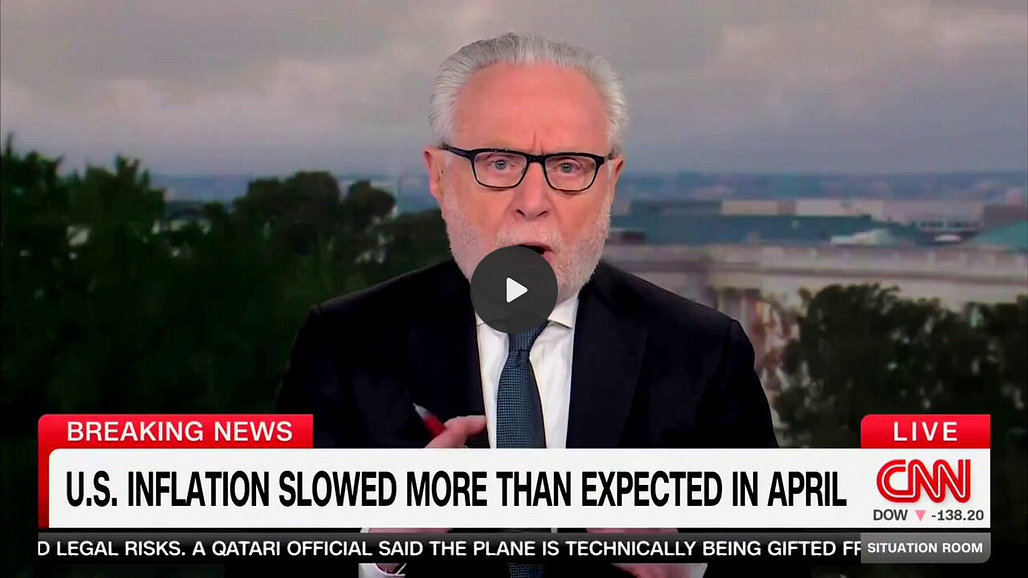
It would be one thing if consumers had paid the $300 billion that the tariffs brought in. But it’s obvious that we haven’t seen a $300 billion increase in the cost of goods. Inflation is at a five-year low. This is not to say that no product has suffered due to the tariffs, but overall, we just aren’t seeing the massive inflation you’d expect from 15-20% tariffs if they were being translated directly into prices.

So why aren’t they being passed on? Why would Walmart and other corporations eat the tariffs and not raise prices?
We all remember when prices spiked during the pandemic due to the supply chain crisis. (Apparently, when your entire supply chain relies on your greatest adversary, and that adversary unleashes a virus that kills millions and the entire global economy gets shut down, you can’t access goods! Who would have thought?! A big part of Trump’s tariffs are to combat the national security hazard presented by this status quo.) Eventually, the supply chain crisis came to an end—but the prices didn’t come down. Instead, corporations realized they could just keep them 15-20% higher, bringing in record profits.
This became known as greedflation, and guess what? Even the WSJ reported on it! Who can forget this banger from 2023: “‘Greedflation’ Is Real—and Probably Good for the Economy.”
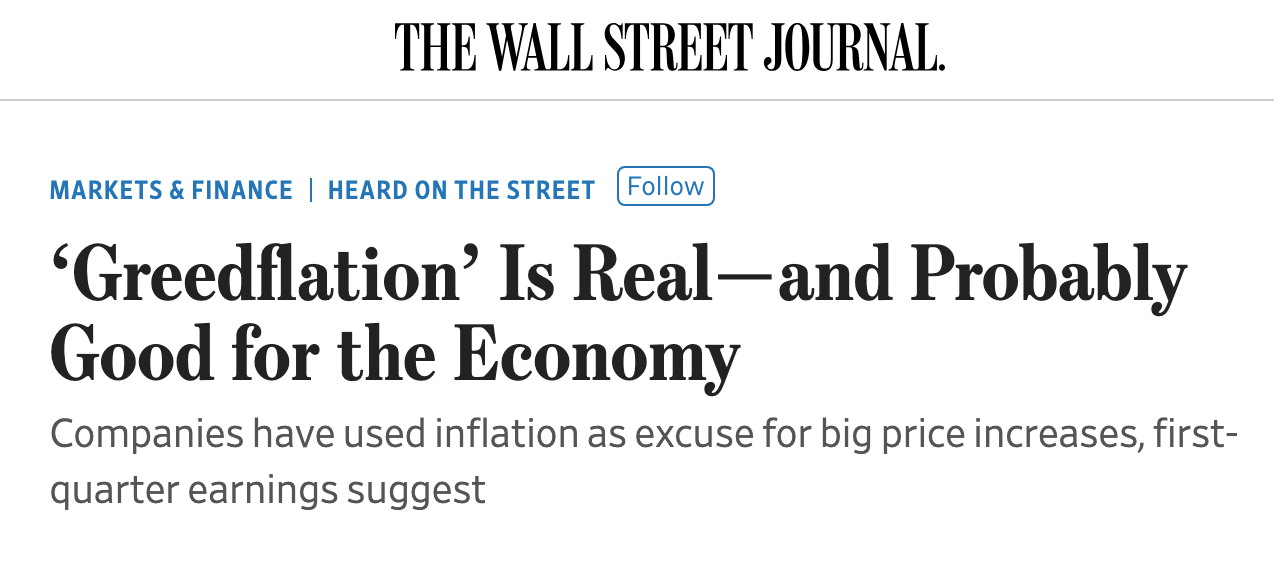
“At the crux of the matter is the politically charged question of whether corporations—setting aside the obvious case of commodity producers—are shifting the burden of inflation to households. The latest results back up the argument that they are,” the WSJ reported.
How interesting! So you’re telling me that corporations have a choice about how they treat inflationary costs on their end: They can choose to pass them on to consumers, as the WSJ admits they did in 2023, or they can choose not to? Fascinating!
It’s pretty funny that the WSJ is perfectly capable of recognizing when corporations do pass costs on to consumers, yet it’s utterly unthinkable that companies might choose not to.
Surely, if the WSJ says the New York Fed has proven that it’s “you” who’s paying the tariffs, then the article must distinguish between corporations eating the cost of the tariffs and corporations passing them on to consumers. Let’s check in with the WSJ’s summary:
They reach that conclusion by examining import data, to see whether foreign suppliers cut their prices in response to Mr. Trump’s added tariff costs. Over the first eight months of 2025, “94 percent of the tariff incidence was borne by the U.S.,” the analysis says, meaning “a 10 percent tariff caused only a 0.6 percentage point decline in foreign export prices.”
This outcome drifted as the year wore on, but only slightly: The figures for November suggest the tariffs had “an 86 percent pass-through to U.S. import prices,” the researchers say. “Our results show that the bulk of the tariff incidence continues to fall on U.S. firms and consumers. These findings are consistent with two other studies that report high pass-through of tariffs to U.S. import prices.”
Ah. Apparently not.
As director of the National Economic Council Kevin Hassett put it, “the paper is an embarrassment.”

The great John Carney has a great in-depth analysis at Breitbart explaining why even the statistic the study claims to show—90% of tariffs are paid by American consumers and firms—is probably bogus, too. “Since Liberation Day, commodities less food and energy—the CPI category most directly exposed to import price pass-through—has risen at an annualized rate of less than half a percent. That is not what 90 percent consumer incidence looks like,” writes Carney.
Indeed. Prices need to come down further. But with inflation at a five-year low, it’s safe to say, we’re not the ones who have paid $300 billion in tariffs.
Correction: An earlier draft of this misstated that we had paid down one fifth of the debt. It is the deficit (obviously!). I regret the error!
"the $300 billion in revenue, which went to pay down one fifth of our *national debt* in just one year."
The national budget deficit, not the national debt (unfortunately).
The tariffs have been a powerful instrument with which to rein in Chinese expansionism. Thousands of factories were forced to close or move to Southeast Asia, throwing millions of people out of work. Many of them received no severance pay, and there are all sorts of reports leaking out of protests and even riots in front of plants and factories by workers who are owed weeks or months of back pay.
When you look past the arrogance and defiance of the official news media in China (and the anti-Trump media in the U.S., much of it beholden to China), you will witness a country in crisis, damaged first by the real estate bubble and now by the crash in international trade. They can't just switch to exporting their products to Asia and Europe, because the U.S. is watching for transshipments, i.e. attempts to bypass the tariffs.
The Communist government's attempts to retaliate with its own tariffs badly backfired. Most of what the U.S. buys from China, except for rare earths and a few other monopolized products, is unnecessary. Whereas, most of what China buys from the U.S. is necessary, for example food products and spare parts for Boeing aircraft. When Xi Jinping banned the import of those spare parts, hundreds of aircraft were grounded, and he was forced to rescind the ban.
As for the tiresome accusations by the American Left that tariffs are somehow hurting the U.S. consumer... well, sure, in the long run, we will indeed pay higher prices for products manufactured domestically, but many products will also just be manufactured in places like Vietnam and Malaysia which have approximately the same cost basis as China.
There is a lot of interest in moving manufacturing plants back to the U.S. to avoid trade uncertainty, and this will doubtless lead to more wealth in the hands of Americans, offsetting any short term costs of tariffs.
Absolutely love your analysis each day! I don’t always agree with everything, but your arguments are all so logical and well-reasoned. Keep up the great work!