
There’s no doubt about it that antisemitism is on the rise. The Democratic Party has become infested with it, elevating those who fundamentally oppose Jews into celebrities. A virulent anti-Zionism has become the only litmus test that matters. And on the far Right, antisemitism has become a way for older media figures to curry favor with the youth and with Muslim audiences, doing their best to create an atmosphere of distrust around Jews based on classic antisemitic language.
It’s led good-hearted Americans, Jewish and non-Jewish, to a state of panic. I am frequently asked by people worried about the future of Jews or of this great nation how to fight antisemitism.
My answer is always the same: Stop “fighting antisemitism.” Recommit to this great nation, which has always loved and protected its Jews.
Because here’s the truth that anyone with any knowledge of American history knows: Antisemitism is not just a betrayal of Jews. It’s a betrayal of America—of its founding values and the vision of our Founding Fathers. Which means you don’t fight it by talking about Jews as a separate, oppressed minority, but rather, as the Founding Fathers did: as a cherished, integral, inseparable part of what makes America so utterly unique, what makes America America.
The United States of America has always had a unique relationship with Jews. In 1790, President George Washington wrote a famous letter to the “children of the stock of Abraham” of Newport, Rhode Island, promising that here, bigotry would be given no sanction, persecution no assistance. In the letter, he explained that Jews, as all other Americans, would be treated as equals, though not due to the tolerance of their neighbors, tolerant though they were; instead, their equal rights would be due to the religious freedoms imbued in us by our Creator. In his explanation, the President was laying out the template for the extraordinary freedom Jewish Americans would be granted here, pretty much from Day 1. The distinction between religious tolerance and religious freedom would come to define how America would treat its Jews—but also how it would define what it means to be an American. It means zealously protecting our rights as a gift of God rather than the result of the sufferance of our neighbors or government.
While the distinction between religious tolerance and religious liberty was not invented for Jews, it takes a person of a different faith to even arrive at such an idea, and Jews would become a symbol for the ideals this country was founded on. In how they promised to and did treat their Jews, Americans would legally, morally, and spiritually ratify the vision of the Founding Fathers. Jews would become the mirror their Christian neighbors held up to themselves as proof of concept—proof they were in good standing with their God.
The distinction between religious tolerance and religious freedom would come to define how America would treat its Jews—but also how it would define what it means to be an American. It means zealously protecting our rights as a gift of God rather than the result of the sufferance of our neighbors or government.
But it went beyond that. There was always the feeling that the very idea of freedom, rights, and equality before the law were ideas that came from what Christians would call the Hebrew Bible, and Jews were the People of the Book, the living, breathing embodiment of the eternal persistence of such divinely inspired thoughts. We had as Jews preceded ourselves here, and it is as the inheritors of the Bible, the stewards of the civilization it contains in its pages, that Jews would be welcomed and cherished in their new home.
Though deeply committed to the separation of church and state, that did not mean the Founding Fathers were not themselves religious. They viewed the hand of God in the freedoms they ratified, which they saw as a sacred covenant; the source of the freedoms they ratified was not human but divine. The Federalist Papers are full of references to “the hand of God” or “the finger of the Almighty,” references to the Bible.
America rejected antisemitism because the Founding Fathers believed they had a covenant with God
It was personal, too. The Founding Fathers knew Jews, and they liked them.
Even prior, America’s colonial history is littered with stories of Jews who became precious to their neighbors, like the Jewish Founding Father Asser Levy, one of the first Jews to step foot on American soil in New Amsterdam in 1654, who quickly became known as the most litigious person in the colony—and yet was universally loved and respected. “Though a litigant is not an amiable character to contemplate, in Levy’s case this characteristic certainly had a good effect,” notes one 19th-century historian. “His honest opposition to imposition and insult, his constant jealousy of his rights, his sterling honesty and integrity, seem to have gained for him the respect and friendship of his Christian fellows.”
Just six years before Asser Levy arrived in America, Ukrainian Cossacks had killed 50,000 Jews in mass pogroms. Now, Asser Levy was suing officials for insulting him, or for failing to perform their jobs well.
From its earliest days, Jewish life in America was destined to be different, and Jews viewed America as the Promised Land where they could fulfill their dream coming home after millennia of being a hated, persecuted minority.
During the Revolution, the Jewish community experienced loss, rape, destruction, and exile along with their fellow countrymen. And they fought hard for victory. South Carolina boasted 34 Jewish Revolutionary War veterans. Francis Salvador, a wealthy Jewish immigrant from England, was the first Jew to serve in an American legislature. He fought bravely, and when he was ambushed by Tories and scalped by Indians, he became the first Jew to die in defense of the new United States.
Mordechai Sheftall, born in Savannah, became head of the Parochial Committee of Christ Church Parish and enforced the boycott of British goods, then assumed the rank of colonel during the war and served as commissary general for Georgia’s militia and Continental troops. Sheftall and his son were taken prisoner, and the British tried to force them to eat pork. “Pork for dinner,” recounts the minister of Savannah, Rev. Moses Allen, who was taken prisoner with the Sheftalls, in his diary. “The Jews Mr. Sheftall & son refused to eat their pieces, & their knives and forks were ordered to be greased with it ... It is a happiness that Mr. Sheftall is a fellow sufferer. He bears it with such fortitude as is an example to me.”
Isaac Franks enlisted at 17. Soon after, he was captured and imprisoned by the British. He managed a daring escape and rejoined the American forces, which he served until 1782, eventually achieving the rank of lieutenant colonel in the Pennsylvania militia. He went on to become a successful businessman and bought the Deshler House in Germantown, a former British army headquarters, which he rented for a season to President Washington in 1793.
But more important than the Jewish military contributions were the Jewish merchants who did business with the states and with Congress, selling goods on credit to the army, serving as quartermasters and purchasing agents, buying bonds, accepting certificates of indebtedness, and serving as moneylenders, blockade runners, even privateers, without whom the Revolutionaries would have starved. And unlike in Europe, they were never resented for playing this critical role. Instead, they were lauded, respected, and even loved. Often, they were not paid back for their loans.
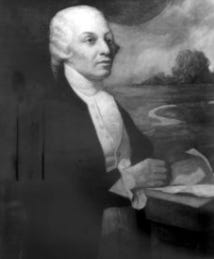
Haym Salomon was perhaps the most famous case, known as the “Financier of the Revolution.” Born in Lissa, Poland, in 1740, by the time he arrived penniless on these shores 35 years later, he had been a wanderer for decades. He managed to pick up a host of languages and skills in finance—as well as the politics of a Revolutionary.
One year after his arrival, Salomon was selling goods to the army on the Canadian frontier when he was arrested in New York by the British and imprisoned. He would have died in jail had he not been released by German mercenaries hired by the British, who needed English speakers to help them procure supplies. So Salomon went to work for the British as a commissionair for the officers. They did not know that he was a spy for the Whigs, persuading Germans to desert and helping imprisoned American and French officers to escape.
When he was betrayed, he fled to Philadelphia, where he established himself as a shopkeeper, bill broker, and moneylender, and due to his ability to speak French, the resident French diplomat and French army paymasters became his clients, which led to him being hired by Robert Morris, Superintendent of the Office of Finance.
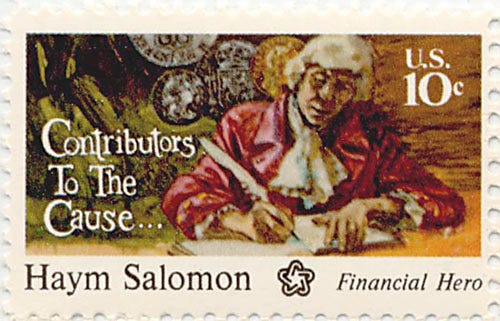
The first time Salomon is mentioned in Morris’s diary, it is as “the Jew broker.” But every subsequent time, it is as “Mr. Salomon.” The stigma of making and lending money had bedeviled the Jews in the most violent ways in Europe, something Salomon must have experienced firsthand as an observant Jew in the Continent. Well, no one told the Americans. Here, it was a good thing to lend people money. Here, it was a good thing to make money! It was as if the land itself were asserting itself to reject the mores of the Old World. Jews like Haym Salomon provided a proof of concept that this time, things would truly be different.
As the war began to turn in favor of the Revolutionaries, the finances of the government got more and more desperate, and Salomon became more and more helpful. “At times Salomon’s credit was better than that of the new republic’s,” notes one historian. “This man was something of an alchemist; he could turn paper into gold.” These were the kinds of epithets that made the Jews hated in Europe. In America, it made them cherished. Salomon was called in to resolve crisis after crisis and worked tirelessly to establish and maintain the credit of the nascent nation. It brought him to the attention of James Madison, who turned to a number of Jewish moneylenders in the early 1780s.
As Madison wrote to a friend in August of 1782, “I have for some time past been a pensioner on the favor of Haym Salomon, a Jew broker.” By September, Madison had a new epithet for Salomon: “The kindness of our little friend in Front Street (Salomon) near the coffee-house is a fund which will preserve me from extremities, but I never resort to it without great mortification as he obstinately rejects all recompense.”
For the Jews, the peace that descended after the war in 1783 “seemed like nothing short of redemption,” writes the eminent historian of the Jews Jonathan Sarna. Congress proclaimed the end of the war just before the start of Passover, the holiday of freedom, and the Jews of America were proud of their achievements, their “zealous attachment to the sacred cause of America in the late war with Great Britain,” as the Jews of New York put it to the governor upon returning with the Sefer Torah they had taken with them into exile in Stratford when the British occupied New York. Before the war, members of the Synagogue Shearith Israel had the custom of standing for the prayer for the government. After the Revolution, they sat for the prayer, “to symbolize the American Revolution’s abolition of subservience,” explains Sarna.
The ratification of the Constitution was one of the most important events in the history of Diaspora Jewry, as one historian called it, making American Jews “the modern world’s first free Jewry.” And yet, it went both ways. Did not the Jews make the rest of the United States free? Were they not the proof of concept of freedom itself, the proof to Christian Americans that they meant what they said? For how could their Christian neighbors know they really meant it, that this country would protect the rights of non-Christians, without some non-Christians to test it out on? Indeed, there would be much higher barriers to Catholic and Mormon equality for much of the history of the United States than there would ever be for Jews.
In the very act of treating them like everyone else, the new United States skirted the pitfalls of European Enlightenment efforts at Jewish emancipation, which always demanded Jews abandon their Jewishness in order to achieve those equal rights. “The Jews should be denied everything as a nation, but granted everything as individuals,” Count Clermont-Tommerre infamously said in France in 1789.
This was never the case in America. Here, people were not granted freedom on any condition; freedom was a gift from God, who wanted His children to worship him in many forms, it turned out. A country that sought His blessing would have to protect the children of the stock of Abraham. Finally, in 1791, this idea was ratified as the First Amendment: “Congress shall make no law respecting an establishment of religion, or prohibiting the free exercise thereof.” It was a promise that, as Jonathan Sarna puts it, the federal government would never again favor one religion over another. The government would protect Jews from legal discrimination, rather than enforcing it upon them. The Jews were in the country not due to the tolerance of their neighbors, but by the grace of God.
We needed a religious country to become free—and it needed us to enshrine those freedoms for all. This, in the end, is the source of America’s exemplary treatment of the Jews: As a result of the mirror the Jews held up to them, which cast them in the light of protectors of God’s bounty, American Christians developed a deep identification with their Jewish neighbors.
Opposing Jews—their heritage or their existence—meant opposing America. Antisemitism in America was always, critically in opposition to the entire project, because the very freedoms that define what it means to be an American were deeply associated with its Jewish citizens.
It was because the early Americans believed they had a covenant with God to protect the rights—God-given—of every person, that Jewish American history is a tale of freedom. Jews helped the new country understand what it was about. Americans would be litigious, like Asser Levy. They would take pride in success and making money, like Haym Salomon. They would protect the religious liberty of their neighbors—and they would not take credit for that, as though liberty were a gift they were bestowing. They would aver. They would credit the Creator for that gift and cast themselves as its protector.
That’s what it means to be an American.
“It is now no more that toleration is spoken of, as if it was by the indulgence of one class of people, that another enjoyed the exercise of their inherent natural rights,” wrote President Washington to the Jews of Newport. And indeed, “tolerance” would always be too weak a word to describe America’s relationship with its Jews.
Stop trying to “fight antisemitism.” Recommit to our history—the fact that we are an inseparable part of what it means to be an American. The obsessive attempt to fight antisemitism is a betrayal of that history in that it seeks to separate us out from the story and the soil from which we have emerged as a community.
That is my prayer for our 250th birthday: that as Americans and as Jews, we reclaim this precious inheritance.
This essay is adapted from my new book The Jews and the Left. You can buy a copy here.

And I will also add, I finished your book the week it came out and I learned a lot!! Excellent book!!! I have recommended it to people!
Beautiful, Batya!!